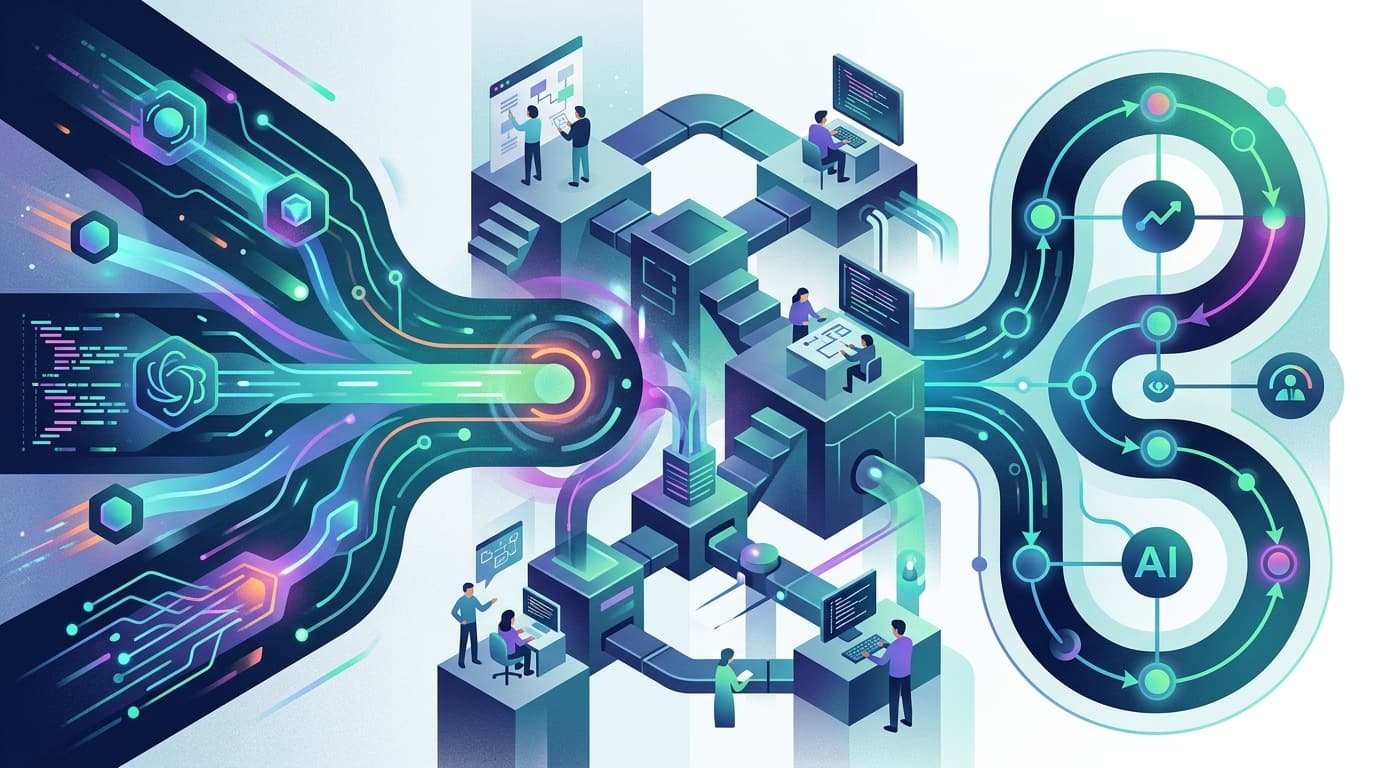

Everyone I talk to right now is excited about how fast agents can write code. And they should be. The implementation step of any software project, the part that used to eat weeks of expensive engineering time, has become almost trivially fast with the right model in the loop.
But here is the thing nobody is talking about loudly enough: writing code was never the only step. It was not even close to the most fragile step. The hard parts were always the stuff around the code: planning, reviewing, testing, deploying safely, watching what happens in production, fixing what breaks at 2am. Agents have gotten dramatically better at the fast part. The slow parts are now the bottleneck, and we built all of those slow parts for humans.
The Real Mismatch Nobody Is Fixing
Think about how a strong engineer operates on your team today. They pick up a ticket, write the code, open a pull request, respond to review comments, watch the deployment, and keep an eye on error rates for the first hour after it goes live. That is one continuous loop of work. They own it start to finish.
Now think about how most teams are using agents. They prompt the agent to write the code. Then a human takes over to review it, merge it, deploy it, and babysit production. The agent did maybe 20 percent of the work. The human is still running the other 80 percent of the process, just with a faster first step.
That is not a software factory. That is a faster typewriter with the same filing system.
The gap is not a model quality problem. Current agents are good enough to handle far more of the lifecycle than we are giving them. The gap is infrastructure. The tools, APIs, and platforms we hand agents were designed with the assumption that a human would be clicking through dashboards, reading error pages with eyeballs, and making judgment calls based on vibes and institutional memory. None of that translates.
What Agents Actually Need to Own the Whole Process
When I think about what it would take to genuinely hand an agent the keys to a software project from idea to production, the list of requirements changes completely compared to what we expect from human-friendly tooling.
Everything has to be programmatic. A human can click a button in a deploy UI. An agent cannot. Every single operation in the pipeline needs a real API. This sounds obvious until you start auditing your actual stack and realize how much of your deployment process lives in a Confluence doc and a Slack message to whoever holds the infrastructure keys that week.
Every agent needs its own isolated environment. When a human developer wants to test something before it hits production, they grab a staging server or spin up a local environment. That works when you have five developers. It breaks completely when you have fifty agents running parallel tasks. Each agent needs its own preview that mirrors production exactly, spawned on demand, torn down when the work is done.
Observability has to push, not pull. Humans can look at a dashboard when something feels off. Agents need events that fire and trigger action. The whole model of "go check the logs" assumes someone is sitting there to go check. An agent-native system sends the signal to the agent. The agent does not go looking for it.
Permissions need to be granular and escalable. Right now, most teams solve the "what if something goes wrong in production" problem by giving a few trusted engineers broad access and hoping they make good decisions. That works because you can fire a human who abuses it and because humans have enough judgment to know when not to use a power they have. Agents need scoped permissions with a clear path to escalate when a task requires something outside the current scope. Without that, you either over-permission the agent (dangerous) or under-permission it (useless).
The system has to get better over time. A new engineer on their first on-call rotation is slow. By month three, they are fast because they have seen things fail and learned from it. Agents need the same mechanism. That means capturing what happened during every run, not just whether it passed or failed, and feeding that back into how the agent handles the next similar situation.
A Pipeline Is Not a Workflow. A Workflow Is Something Better.
Here is an analogy I use with clients. A CI/CD pipeline is like a conveyor belt in a factory. It moves things in one direction, at a fixed pace, through fixed stations. That is fine when the process is predictable and linear. But software is not a conveyor belt. A bug that only reproduces on a specific device from a specific country is not a conveyor belt problem.
A workflow is more like a skilled general contractor. They know the sequence of work roughly, but they spawn subcontractors dynamically based on what they find when they open the walls. They pause when an inspection is required. They escalate when a structural issue shows up that was not on the original plan. They keep state across days and weeks, not just for the duration of a single build.
That kind of flexible, stateful orchestration is what agent-driven software development actually needs. Not a YAML file with twenty steps. A system that can decide mid-run to spawn a browser, run a visual regression check, read the production error rate, and only proceed to deploy if three independent signals agree that the change is safe.
What the New Lifecycle Looks Like in Practice
If I were advising a mid-size engineering team on how to start building toward this today, I would not tell them to throw out their existing process. I would tell them to audit every human-in-the-loop step and ask one question: is this human here because the decision genuinely requires human judgment, or because no one built the API to let a machine do it?
Most of those steps fall into the second category. The human is not there because the decision is hard. The human is there because the tooling was never built for anything else.
The practical roadmap usually looks like this:
- Identify the five most common interruptions in your current deployment process. Not the edge cases. The regular stuff that slows things down every single week.
- For each one, ask whether an agent with the right context and permissions could handle it. If yes, what would it need: an API, a permission, an event trigger, a memory of past decisions?
- Build the plumbing for those five things before you worry about the other forty. One well-automated step that actually works is worth more than a grand vision that stalls in planning.
- Instrument everything from day one. Traces, logs, outcomes. You cannot improve a system you cannot observe, and you cannot teach an agent from experience it has not recorded.
The teams I see making real progress here are not the ones with the biggest AI budgets. They are the ones who treat the agent as a colleague that needs the same things a human colleague needs: context, tools, feedback, and the ability to escalate when something is outside their lane.
The Honest Part
I am going to say something that tends to make the pure-automation crowd uncomfortable. Not every step in the development lifecycle should be handed to an agent yet. Design decisions that require understanding what a customer actually feels when they use something, architectural choices that depend on a three-year strategic bet, the call about whether to pull a feature at 11pm on a Friday: those still need humans.
The goal is not zero human involvement. The goal is that the humans involved are spending their time on the things that genuinely require human taste and judgment. Right now, most engineering teams are spending enormous human hours on things that are just process. Review this. Approve this. Re-run this because it flaked. Check if the metrics look okay.
That is the work agents should own. And the only reason they do not yet is that we have not built the environment they need to own it safely.
The teams that build that environment in the next 18 months are going to look very different from the ones that do not. Not because they will have fewer people. Because the people they have will be doing entirely different, and more valuable, work.