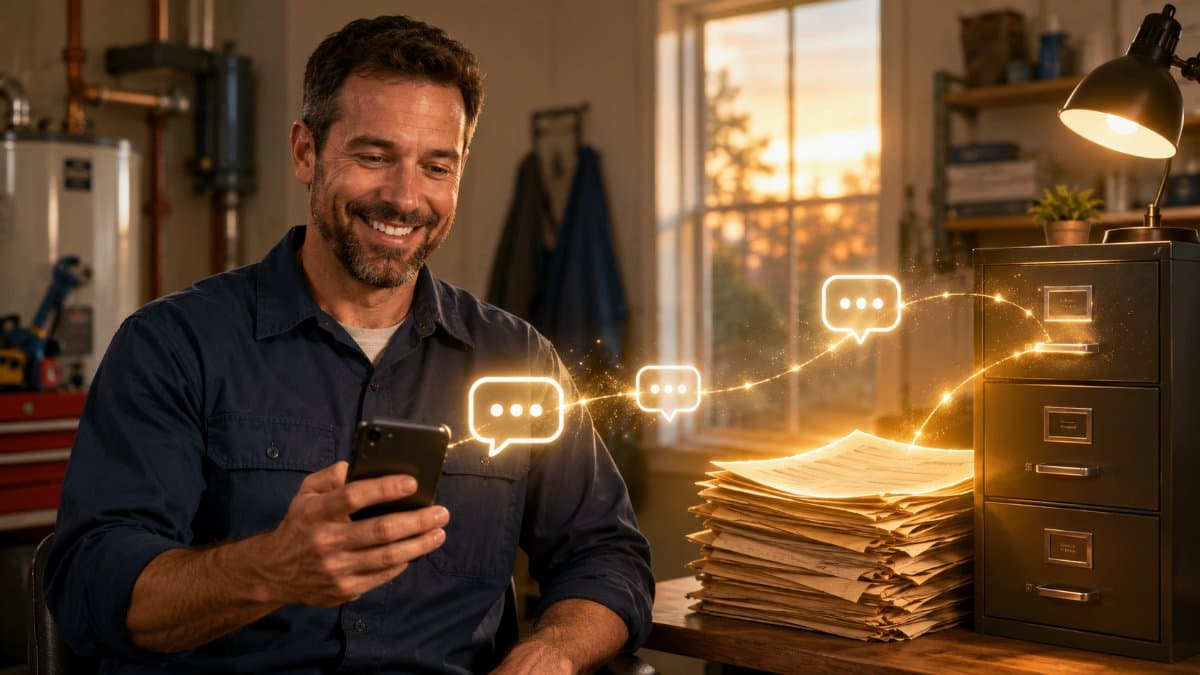

Somewhere in your office there's a list of every customer who has ever paid you. It might live in QuickBooks, in your invoicing app, in an old spreadsheet, or in a filing cabinet full of work orders. For most service businesses that list has hundreds of names on it. And most of those people haven't heard from you since the day the job wrapped up.
Meanwhile, you're spending real money to find strangers. Google ads, lead services, door hangers, maybe a wrap on the truck. New customers are expensive, and they're getting more expensive every year. The odd part is that the cheapest customers you'll ever get are already sitting in that list, and almost nobody contacts them.
This post walks through how small businesses are using AI to text and email their old customer lists, handle the replies, and book jobs, all without hiring anyone or spending a dime on new ads. It's one of the fastest paybacks in all of small business automation, and it works whether you run an HVAC company, a landscaping crew, a detail shop, a distribution business, or a marketing agency.
The list you already paid for
Think about what it cost you to earn each name on that list. You paid for the ad or the referral program that brought them in. You paid someone to answer the phone. You drove out, quoted the work, did the job, and sent the invoice. Every customer on that list represents money you already spent.
Marketing researchers have measured this for years, and the numbers are lopsided. Winning back a past customer typically costs a fraction of what it costs to land a new one (often five to ten times less), and past customers say yes far more often because they already know you, trust you, and have your work in their home or business.
Yet the standard playbook for most owners is to finish the job, send the invoice, and never reach out again. Not because they don't care, but because nobody has time. Following up with 600 old customers by hand is a week of tedious work, so it never happens.
That's exactly the kind of job AI is good at.
Why this beats buying more leads
Before we get into the how, it's worth being clear about why this works so well.
A stranger who clicks your ad doesn't know you. You're competing with three other companies for the same lead, racing to call first, and hoping your price wins. Close rates on purchased leads are often in the single digits, and each lead can cost anywhere from 40 to a few hundred dollars depending on your trade.
A past customer is a different conversation entirely. They've seen your truck in their driveway. They know the work got done. When you text them "Hi Sarah, it's been about a year since we serviced your furnace, want us to get you on the fall schedule?" there's no salesmanship needed. You're a familiar company doing them a favor by remembering.
The results back this up. One 2026 analysis of AI-run win-back campaigns reported a win-back rate of nearly 30 percent on dormant customer lists. A contractor case study made the rounds this year describing over $145,000 in booked work from a single reactivation push into an old customer spreadsheet. Even if your results land at a quarter of that, the math still beats almost anything else you could do this month, because the cost is close to zero.
What an AI win-back campaign actually looks like
Here's the whole thing in plain terms.
First, you export your customer list. Name, phone number, email, what you did for them, and when. That's it. Every invoicing tool can produce this in a couple of clicks.
Second, the AI sorts the list. It figures out who's overdue for service (the furnace tune-up from 14 months ago), who bought something with a natural repeat cycle (lawn treatments, filter changes, quarterly pest control, reorder-able supplies), and who simply went quiet. It also flags bad numbers and duplicates so you're not texting the same person twice.
Third, it sends a short, personal message to each customer. Not a blast. Not a newsletter. A text or email that reads like it came from you, referencing the actual work you did, going out in small batches over days or weeks.
Fourth, and this is the part that changed recently, the AI handles the replies. When a customer answers "how much is a tune-up these days?" the AI responds with your pricing, answers the follow-up question, and offers appointment times from your calendar. When someone asks something tricky or gets frustrated, it stops and hands the conversation to you. When someone says "take me off your list," it does, immediately and permanently.
Fifth, booked jobs land on your calendar. You find out about the whole exchange when the appointment shows up.
Two years ago, steps three through five needed a person. Today the reply handling is good enough that owners routinely wake up to booked jobs from conversations they never saw.
What the messages sound like
The tone matters more than anything else in this whole system. Good win-back messages are short, specific, and easy to ignore without guilt. A few examples:
For an HVAC company: "Hi Mike, this is Dave's Heating and Air. We replaced your AC capacitor back in May of last year. Summer's coming and we're booking pre-season checkups this month. Want me to hold a spot for you?"
For a landscaper: "Hi Karen, it's GreenLine Lawn Care. We did your spring cleanup last year and you mentioned maybe adding mulch this time around. We're routing your neighborhood the week of the 20th if you'd like a quote."
For a distributor: "Hi Tom, it's Jenny at Midwest Supply. Your shop usually reorders cutting fluid about every 90 days and it's been 4 months. Want me to send your usual order out this week?"
Notice what's missing: no coupon-speak, no ALL CAPS, no fake urgency. Just a business remembering its customers. The AI writes these from your job history, so each one references real work, and you approve the templates before anything goes out.
Real numbers for a small campaign
Let's run the math on a modest example. Say you're a plumber with 500 past customers and your average job is $400.
You send a friendly check-in to all 500 over three weeks. Based on typical response rates for this kind of outreach, somewhere between 8 and 15 percent will reply, and roughly a third of those will book. Call it 20 booked jobs on the low end. That's $8,000 in revenue from a list that was sitting in a drawer, and most of those customers are now back on a cycle where they'll hear from you again next year.
Compare that to buying 20 jobs' worth of leads. At single-digit close rates and $60 per lead, you'd need several hundred leads and thousands of dollars in ad spend to book the same work, plus dozens of hours on the phone chasing them.
The reactivation campaign costs you an afternoon of setup and a modest monthly software fee. It's not even close.
How to get started this week
You don't need to boil the ocean. A simple first campaign looks like this:
Pull your list. Export customers from your invoicing or field service software with name, contact info, last job, and last job date. Don't worry about making it perfect.
Clean the obvious problems. Remove anyone who had a bad experience, anyone with an open dispute, and anyone you simply don't want back. You know who they are.
Pick one offer. A seasonal checkup, a reorder reminder, a "we're in your neighborhood" slot. One clear reason for the message, not a menu.
Start with 50 people. Send the campaign to a small batch first. Read every AI-handled conversation for the first week. You'll catch anything that sounds off and tighten the templates.
Then open it up. Once the replies look right, let it run through the rest of the list in daily batches, and set it to re-check the list every month for customers who've newly come due.
If you already have automated review requests or invoice reminders running, this slots right into the same system. We've written before about how those work in how to get more 5-star reviews on autopilot and getting paid faster with AI invoice follow-up, and the win-back campaign uses the same plumbing: your customer data, plus AI that can hold a short conversation.
What to watch out for
A few honest cautions, because this can go wrong if you're careless.
Get the texting rules right. In the US, texting customers requires their consent and every message needs a simple way to opt out. Past customers you have a genuine relationship with are generally fine to contact, but your setup should honor opt-outs instantly and keep records. Any decent tool handles this for you; make sure yours does before you send anything.
Don't overdo the frequency. One thoughtful message and one gentle follow-up is a campaign. Five messages is spam, and it burns trust you spent years building.
Keep a human in the loop early. Read the conversations for the first few weeks. The AI will handle 90 percent of replies cleanly, but you want to see the other 10 percent while you're tuning things.
Don't fake the personal touch. If the message says "it's Dave," Dave should actually see the booked appointment and know the context when he shows up. Customers forgive automation; they don't forgive feeling tricked.
The quiet advantage
Most of your competitors will never do this. They'll keep paying more every year for the same shared leads, while their own customer lists gather dust. The businesses that set up a win-back system get something close to a private lead source: warm, exclusive, and nearly free.
If you'd like help pulling your list together and getting a campaign like this running, this is exactly the kind of project I help small businesses with. Reach out through etomco.com and I'm happy to talk through what it would look like for your business.
See it
Want the whole flow on one page? Take a look at the simple diagram of how an AI win-back campaign works, from the old customer list all the way to a booked job on your calendar.