
Executive Summary
Key Takeaways
- Robust and interoperable agent automation systems can be built by layering Model Context Protocol (MCP) with Agent-To-Agent (A2A) protocol.
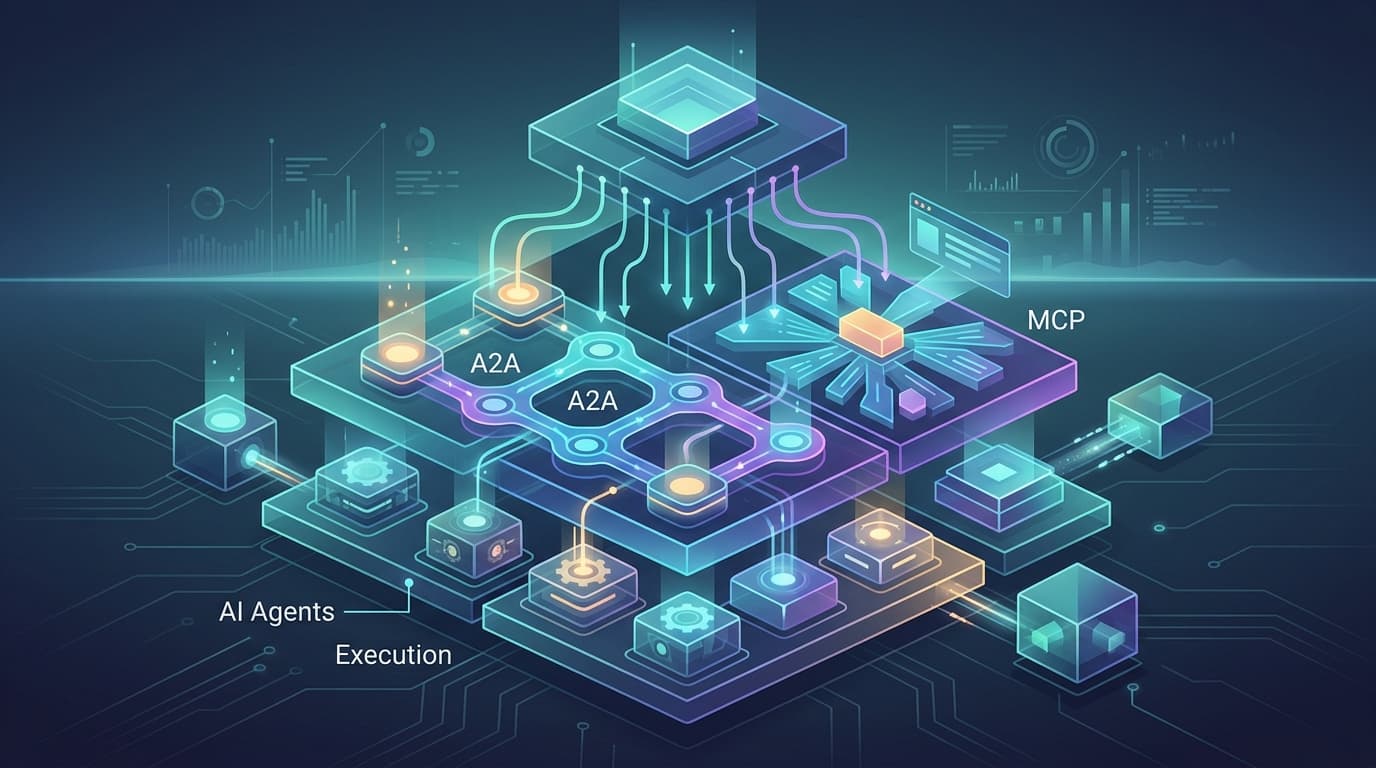
- A2A provides the communication bus between agents, while MCP acts as a universal language for agent capabilities.
- A layered agent-based approach allows for more extensible systems, where new capabilities can be added without altering the core communication logic.
- This architecture facilitates moving beyond rigid, monolithic systems to agile, agent-driven operations.
Understanding A2A: The Agent-to-Agent Communication Bus
A2A is designed to enable secure communication between AI agents from different vendors across various systems. It promotes interoperability in multi-agent environments, which unlocks modular workflows, reduces vendor lock-in, and enhances scalability. Each agent has an "Agent Card" that describes its capabilities, supported protocols, and acceptable request types, facilitating discovery and interaction without exposing sensitive details.
Understanding MCP: The Domain-Specific Language
MCP standardizes how AI systems connect to tools, services, and data sources, acting as a universal interface for integrating AI applications with external resources. MCP servers expose tools (actions), resources (structured data), and prompts (predefined templates). MCP allows agents to discover and use tools or resources on the network without requiring custom integration logic.
MLOps Workflow Example
The article demonstrates the layered architecture using an MLOps workflow for validating and deploying machine learning models. This system comprises three specialized agents: an Orchestrator Agent (coordinator), a Validation Agent (focused on model validation), and a Deployment Agent (responsible for deploying validated models). The Orchestrator uses A2A to discover specialist agents, while the Validation and Deployment Agents use MCP to access necessary tools.
Bottom Line
This layered A2A-MCP pattern offers a flexible and scalable approach to building agentic systems, extending beyond MLOps to any domain requiring dynamic collaboration and adaptable access to capabilities. It enables AI agents to transition from isolated tasks to coordinated intelligence, unlocking unprecedented levels of automation and adaptability. Organizations can leverage this architecture to evolve from rigid pipelines to dynamic, agent-driven operations that adapt to changing business logic and requirements.
Frequently Asked Questions
What is Agent-to-Agent (A2A) protocol?
A2A is a communication protocol designed to enable AI agents from different vendors to securely communicate across various systems. It facilitates interoperability in multi-agent environments, allowing agents to discover and interact with each other without hard-coded connections.
What is Model Context Protocol (MCP)?
MCP is a protocol that standardizes how AI systems connect to tools, services, and data sources. It provides a universal interface for AI applications to access external resources and tools without requiring custom integration logic.
How do A2A and MCP work together in the described architecture?
In the layered architecture, A2A provides the communication bus, allowing agents to discover and task appropriate specialists. MCP acts as a universal language for capabilities, ensuring that once tasked, an agent can discover and utilize the necessary tools regardless of its underlying implementation.
What are the benefits of using a layered A2A-MCP architecture?
The layered A2A-MCP architecture promotes extensibility, interoperability, and adaptability in multi-agent systems. It enables organizations to move from rigid pipelines to dynamic, agent-driven operations, allowing for incremental capability additions and adaptive coordination.
What is an Agent Card in the context of A2A?
An Agent Card is a description of an agent's capabilities, supported protocols, and acceptable request types. It enables other agents to discover and interact with the agent without exposing sensitive details. It is a key element for interoperability in an A2A environment.
Source: https://www.infoq.com/articles/architecting-agentic-mlops-a2a-mcp/